Your MPI Completion Rate Is Your Biggest Revenue Leak
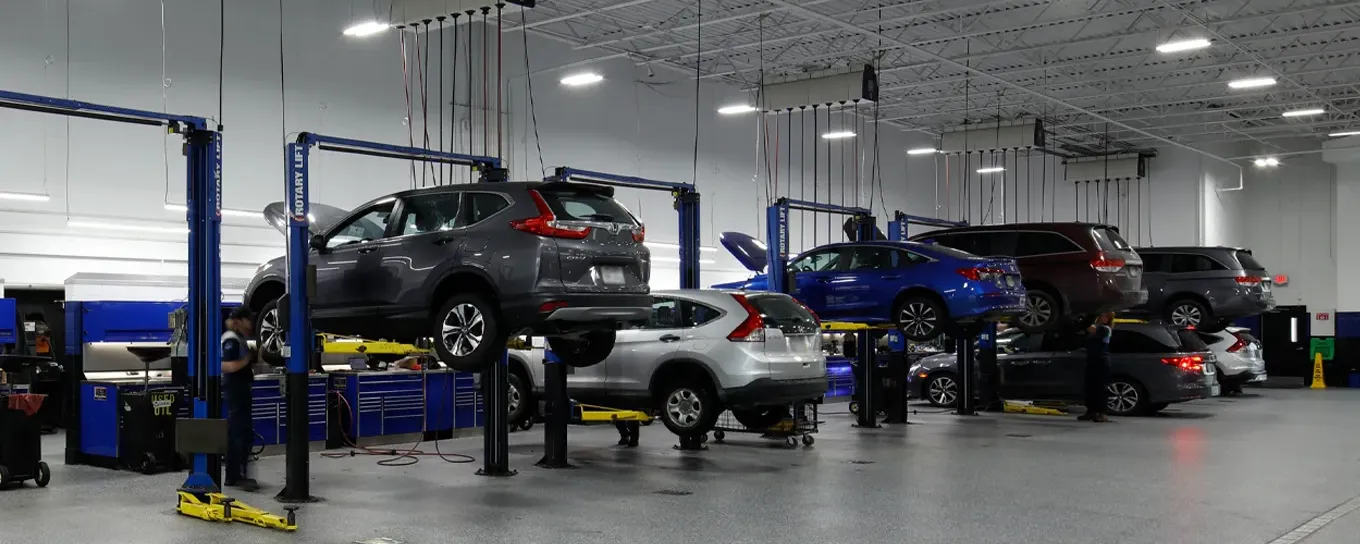
Pull up your MPI completion numbers from last month. Not the ones from your DMS report that count “started” inspections. The real number: how many vehicles left your shop with a fully documented multi-point inspection that included actionable findings for the advisor to present?
For most shops, that number sits between 35% and 45%. That means 55 to 65 out of every 100 vehicles roll out of your bays with zero additional service recommendations. No deferred work logged. No customer-pay opportunities identified. No warranty findings documented.
Every one of those incomplete inspections is revenue you already paid to discover but never collected.
Why MPIs Get Rushed or Skipped
Talk to your techs about MPIs and you will hear the same things across every shop in the country.
Time pressure kills thoroughness. A tech with six ROs on the board and a promise time in two hours is not going to spend 15 minutes tapping through a tablet inspection form. The math does not work. They will eyeball the vehicle, check the obvious items, and move on to the work that actually pays their flat rate hours.
The interface fights the workflow. Most MPI tools require the tech to stop working, clean their hands, pick up a tablet, navigate through screens, and tap condition codes for dozens of line items. That process takes a tech out of their diagnostic flow. It turns a skilled mechanic into a data entry clerk. And it happens at the worst possible time, right when they are in the middle of figuring out what the car actually needs.
Techs do not get paid enough to care. At most stores, a completed MPI pays nothing extra. The tech’s incentive is to finish the flagged work, not to hunt for additional findings on a form nobody reads. When the inspection feels like busywork instead of a revenue tool, it gets treated like busywork.
The result is predictable. Inspections get half-completed. Findings get missed. Advisors get nothing to sell. And the vehicle leaves your shop with $200 to $400 in undiscovered work sitting right there on the lift.
The Revenue Math on a 20% Improvement
Let’s walk through what even a modest improvement looks like.
Say your shop sees 800 ROs per month and your real MPI completion rate is 40%. That means 320 vehicles get a full inspection and 480 do not. Industry data shows a completed MPI generates an average of $180 in additional recommended work (a mix of customer-pay upsell and deferred maintenance). Approval rates on MPI-discovered work typically run between 30% and 40%.
At 40% completion with a 35% approval rate:
- 320 completed MPIs x $180 average recommended work = $57,600 in discovered opportunities
- $57,600 x 35% approval rate = $20,160 in additional monthly revenue
Now raise your completion rate by 20 points to 60%:
- 480 completed MPIs x $180 = $86,400 in discovered opportunities
- $86,400 x 35% approval rate = $30,240 in additional monthly revenue
That is an additional $10,080 per month, or roughly $121,000 per year, from work that was already in your bays. You did not need more cars. You did not need more techs. You just needed to capture what was already there.
And this math is conservative. It does not account for the warranty findings that a thorough inspection surfaces. It does not account for the deferred work that comes back as future appointments. It does not account for the customer trust that builds when you consistently present documented vehicle health information.
Why Traditional MPI Tools Fail
The problem is not that your techs are lazy. The problem is that every MPI tool on the market asks them to stop being technicians and start being typists.
Tablet-based inspection forms were an improvement over paper checklists, but they still interrupt the workflow. A tech cannot hold a flashlight in one hand, point at a worn brake pad, and tap a tablet with the other. So they wait. They batch their findings. They try to remember what they saw 20 minutes ago. And details get lost.
This is the same interface problem that plagues every screen-based tool in the service bay. Techs work with their hands. Any tool that requires them to stop using their hands is fighting against the fundamental nature of the job.
Voice-First MPI Changes the Equation
The fix is not a better tablet form. It is removing the tablet from the equation entirely.
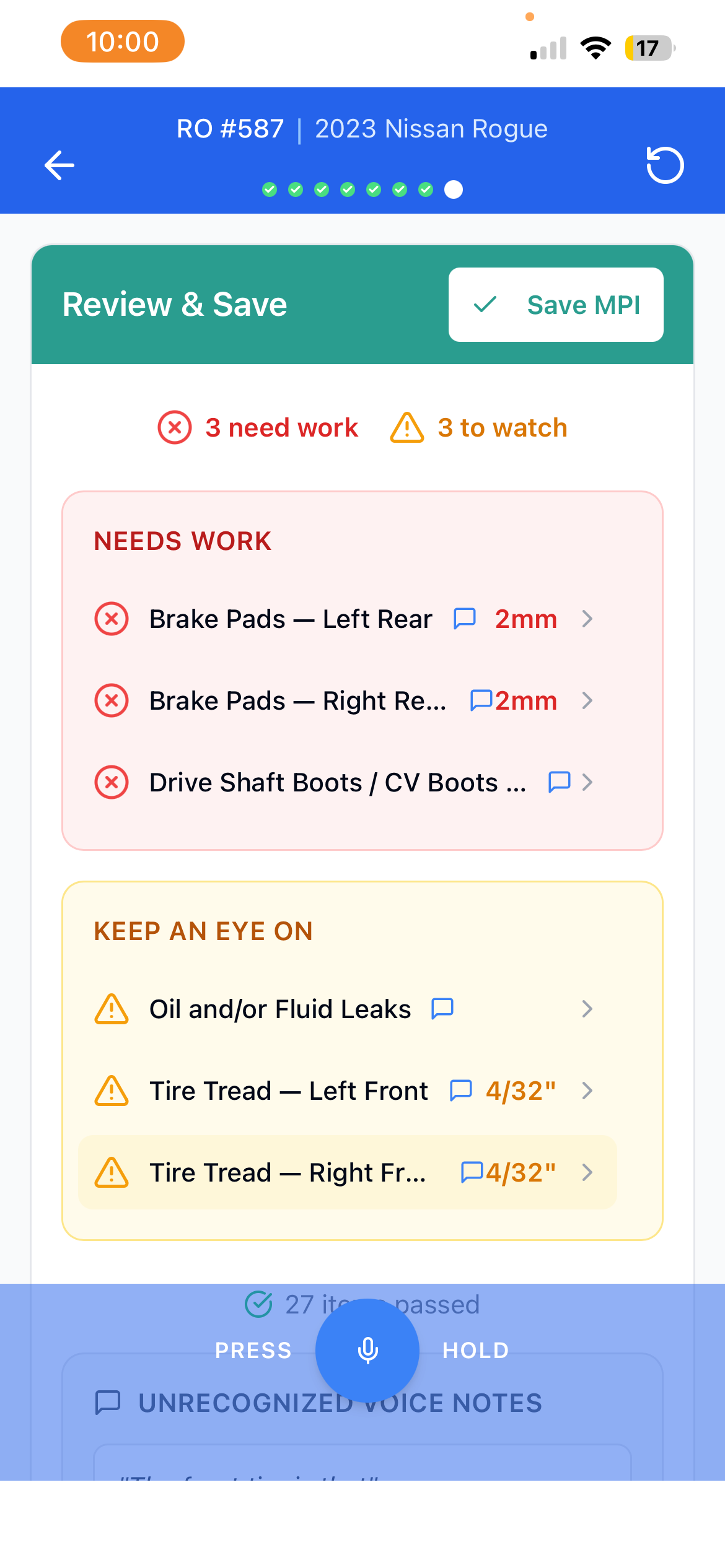
A voice-first MPI lets the tech speak their findings as they discover them. Standing at the wheel, they say what they see. Under the hood, they call out what they find. On the lift, they describe the condition of every component as they look at it. The inspection happens in real time, inside the natural flow of the work, not as a separate task bolted on after the fact.
This matters for three reasons.
Speed. A voice-driven inspection takes a fraction of the time because the tech never stops working. There is no context switching. No cleaning hands to tap a screen. No scrolling through menus. They talk while they work, and the inspection builds itself.
Completeness. When capturing a finding takes two seconds of speech instead of 30 seconds of tapping, techs capture more. The marginal cost of documenting one more item drops to nearly zero. Items that would have been skipped on a tablet get called out by voice because it takes almost no effort.
Quality. Voice captures detail that checkboxes cannot. Instead of “brakes: yellow,” you get a tech describing exactly what they see, with measurements, context, and professional judgment. That gives your advisors real information to present to the customer and real documentation for your records.
The shops that have moved to voice-first inspections are seeing completion rates climb 20 to 30 points within the first month. Not because they hired better techs or added inspection bonuses. Because they removed the friction that was preventing good techs from doing thorough inspections in the first place.
This Is the “Find More Work” Problem
Your techs are already looking at every vehicle. They already have the knowledge to identify what needs attention. The gap is not in their skills. It is in the capture process. And that gap shows up directly in your numbers: every uncaptured finding is a billable hour that never reaches the RO, a quiet drag on your effective labor rate.
When you calculate the full ROI of improving your inspection workflow, MPI completion is almost always the single biggest lever. It sits at the top of the revenue funnel. Every downstream number, customer-pay recommendations, approval rates, deferred work follow-ups, warranty documentation, depends on what gets captured during the inspection.
A 20% improvement in completion rate is not aspirational. It is what happens when you stop asking techs to fight their tools and start giving them tools that match how they actually work.
See It in Your Shop
Your bays already have the cars. Your techs already have the expertise. The only question is whether the work gets captured or walks out the door.
If you want to see what voice-first MPI looks like on your shop floor and run the revenue math with your actual numbers, book a demo. We will walk through it in 15 minutes.