Your A-Techs Aren't Leaving for a $5k raise.
Your best master tech walked last Friday. The exit form says “compensation.” The sign-on bonus across town was three thousand dollars. That is not why they left.
TL;DR. The reason dealership techs quit is rarely the rate. It is the mix. Flat-rate pay punishes the A-techs who get stuck on the warranty bench, parts delays burn flag time, comebacks back-flag their labor, and weak 3Cs documentation turns paid warranty work into denied claims. Pay raises slow the bleed. Dispatch, parts flow, and documentation friction stop it.
How dealership techs actually get paid
Quick primer if you do not work the bench. Almost every dealership tech in the country gets paid on flat rate. A job has a book time set by the manufacturer for warranty work, or by Mitchell or Motor labor guides for customer pay. The tech’s paycheck is book hours times their flag rate, regardless of how long the job actually took.
A few realities baked into that structure:
- Customers pay $120 to $150 per hour at the door. The tech sees $25 to $35 per flag hour at the top end. Less below that.
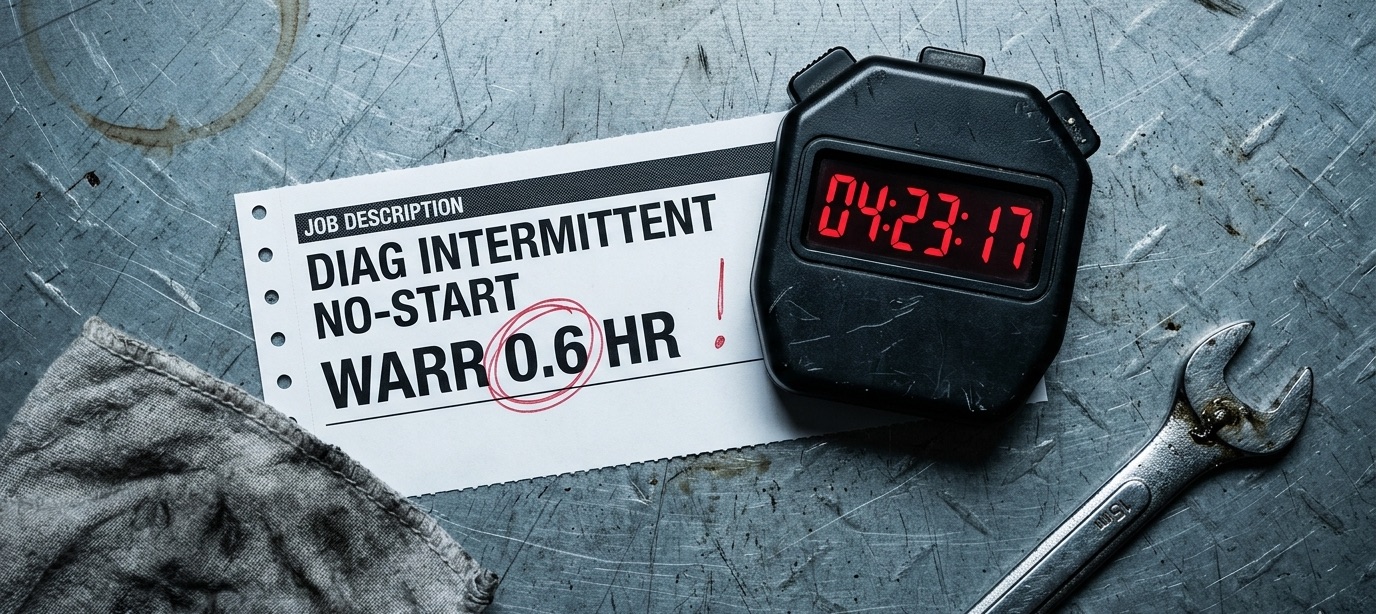
- Warranty book times are tight. OE labor guides assume a clean, never-rusted vehicle with everything coming apart on the first try. Rust-belt techs run over book on warranty work constantly. The most-passed-around tech meme of last year captured it: “getting paid 0.6 hours for a 4-hour job.” Variations of the same joke run on shop-floor Instagram constantly, like this POV of a tech six hours into a thirty-minute job.
- Time spent waiting on parts, training, or a dispatch decision pays zero. Techs are at the shop 45 to 50 hours a week and flag 25 to 35. The delta is unpaid.
- Comebacks back-flag the original tech. If a car comes back for the same complaint, the original tech’s flag hours come off their next paycheck. They did the job, eat the labor twice, and own a customer relationship that is already on fire.

WANT TO BE PAID:
Why are dealership techs really leaving?
Five themes come up in nearly every technician forum, exit interview, and shop-floor conversation. None of them lead with the rate.
1. The dispatch trap punishes your best techs
This is the most counterintuitive one. Your master tech is the only one in the building who can handle the hard diag and the gnarly warranty work, so dispatch routes those jobs their way all day. Warranty pays the worst book times. Diag dogs run over book. The A-tech ends the pay period flagging fewer hours than the B-tech doing brake jobs in the next bay.
Auto Dealer Today profiled a top, most-certified tech who could not crack 120 percent productivity. Once dispatch was rebalanced to feed him a normal customer-pay mix, his productivity jumped past 130 percent in a single quarter. He did not get any faster. He stopped getting punished for being good.
If your retention conversations are about pay rates while your dispatch board still routes every warranty and diag job to your top three techs, the rate is not the problem.
2. Flat-rate volatility
One slow week, one parts-delay week, one snowstorm closing the service drive for two days, and the paycheck tanks. The phrase that shows up in tech voice constantly: “empty bay, empty paycheck.” It is not the average earnings techs hate. It is the variance.
Hourly base plus production bonus structures, offered by a small but growing share of dealer groups, consistently rank as the single most-wanted compensation change in technician surveys.
3. Parts delays and bench downtime
When parts is late, the tech sits. Sitting flags nothing. Tech complaints about parts are constant on forums, and they are not about quality. A 90-minute wait for a part that should have been pulled at write-up costs the tech an hour and a half of unpaid time plus the next dispatch.
This is operational, not a tech-attitude problem. Shops where parts and service operate on the same beat (parts pre-pull at appointment, dedicated runner roles, kanban racks at the bay) lose fewer techs.
4. The service writer is the villain
In tech voice, customers almost never come up as a complaint. Service advisors do, constantly. Three-word ROs (“check brakes”). Concerns reworded in ways that miss the customer’s actual issue. “Give the customer a break and deduct the technician.” An advisor who oversells creates an unwinnable inspection. An advisor who undersells leaves the diag time unrecoverable.
If your exit interviews quietly point at one or two SAs over and over, that is a real signal. Tech-advisor dynamics are the daily texture of the job.
5. The warranty documentation tax
Warranty payment is conditional on a 3Cs story (Complaint, Cause, Correction) that satisfies the auditor. A weak story means a denied claim. A denied claim means the tech eats the labor. So on top of the warranty book time being tight, the administrative burden of getting paid for warranty work falls on the person who already lost on the book-time math.
This is where documentation actually matters for retention, and it is the part most “tech retention” advice gets backward. The pain is not “techs hate paperwork.” The pain is the paperwork directly decides whether they get paid for work they already did. For deeper context on the audit side of this, the warranty audit playbook breaks down what auditors are flagging now.
What “the next shop” is offering
When techs move dealer-to-dealer (not out of the trade entirely), the pull factors are operational, not financial alone:
- Hourly base plus production bonus, or a guaranteed weekly minimum.
- Honest answers to “what is your customer-pay versus warranty mix?” This is now the most-asked tech-side interview question in WrenchWay’s job-search data.
- Manufacturer-paid training counted as flagged hours rather than off-clock.
- A dispatcher who rotates gravy and diag work fairly.
- Tool reimbursement programs (rare, which is why they win when they exist).
- Climate-controlled bays. AC keeps showing up in exit data, particularly for techs under 30.
Techs leaving the trade entirely (going to indy shops, fleet, or out of the industry) usually cite flat-rate fatigue plus tool debt plus corporate pace. That cohort is harder to win back. The dealer-to-dealer mover is who you are competing for.
The retention math, one A-tech, one year
The order of magnitude that matters:
- One bad warranty story leads to one denied claim, which is roughly two to four unpaid book hours per incident.
- An A-tech doing 60 percent warranty mix at even a 10 percent denial rate is losing several hundred flag hours a year they performed work for.
- The math closes before you get to retention. Retention sits on top.
What retention-leading shops actually do
From shops with single-digit annual turnover (the industry average sits closer to 30 to 40 percent in many markets):
- Audit dispatch quarterly. Pull the warranty-vs-CP mix per tech for the last 90 days. If your top three techs are above 50 percent warranty mix while your B-techs sit under 30 percent, you have a dispatch problem, not a pay problem.
- Treat parts flow as a service KPI. Track minutes from write-up to parts on the bench. The shops that fix this lose fewer techs without ever changing the rate.
- Reduce the documentation burden on the tech. Voice-first 3Cs capture shifts story-writing from a typing problem to a talking problem. The tech narrates, the system structures, the warranty admin signs off. Same story quality, less of the tech’s day on it. (Story quality is the single biggest factor in claim approval; the question is who carries the keyboard burden.)
- Be honest in interviews about mix. Techs ask. The shops that answer cleanly attract the techs who would otherwise have left in 18 months anyway.
- Make tech output visible. Techs who see their dictated story graded, posted to the RO, and used by the advisor to sell follow-up work stay longer. This part is cultural, not technological.
A 90-day retention play
If you want to test this against your own turnover:
- Weeks 1 to 2. Pull dispatch reports. Calculate warranty mix per tech. Identify your top three techs and their current mix.
- Weeks 3 to 6. Rebalance dispatch with a target of no tech exceeding 45 percent warranty mix. Audit the last 30 denied claims and see how many traced back to documentation gaps.
- Weeks 7 to 12. Pilot a voice-first 3Cs workflow with two A-techs working warranty-heavy. Measure denial rate, flag hours per pay period, and tech-reported satisfaction.
You will not solve tech retention with any single change. But the cheapest, fastest moves are operational, and the most expensive ones (raising the rate, signing bonuses) are usually the slowest to actually move retention. The shops that figure this out first will be the shops still staffed in 2027.
Frequently asked questions
Why are dealership technicians quitting?
Pay rate is one factor, but the bigger drivers are operational. Techs leave because flat-rate pay creates income volatility, dispatch routes the worst-paying warranty work to the best techs, parts delays kill flag time, and bad 3Cs documentation turns paid warranty work into denied claims. Shops that fix the operational friction retain better than shops that just raise rates.
How does flat-rate pay work for dealership technicians?
A job has a book time set by the manufacturer for warranty or by labor guides for customer pay. The tech’s pay is book hours times their flag rate, regardless of actual time spent. Customers pay $120 to $150 per hour at the door; the tech sees $25 to $35 of that at the top end.
What is back-flagging in a service department?
When a vehicle comes back for the same complaint, the original technician’s flag hours come off their next paycheck. The tech effectively eats the labor twice and owns a customer relationship that has already gone wrong.
What is the average dealership technician turnover rate?
Industry data puts dealership service technician turnover in the 30 to 40 percent range annually in many markets. Top-performing shops hold it in the single digits, generally through operational improvements like balanced dispatch, fast parts flow, and documentation workflows that reduce the admin burden on the technician.