How to Reduce Warranty Claim Denials at Your Dealership
You already know warranty denials are a problem. What you might not know is how much money is walking out the door because of them.
Industry-wide, roughly 12% of warranty claims get denied. About 30% fail on their first submission and need to be reworked. And when you add up the lost revenue, the rework hours, and the claims that never get resubmitted at all, most dealerships are losing 5 to 10% of their total warranty revenue to documentation issues alone.
Not parts issues. Not labor time disputes. Documentation.
The stories your techs write (or don’t write) are the single biggest factor in whether a claim gets paid or kicked back. And the fix is more straightforward than most people think.
Why OEMs Deny Claims
Talk to anyone who reviews warranty claims on the manufacturer side and you will hear the same complaints over and over:
1. Incomplete complaint documentation. The customer said “it makes a noise.” That is what the advisor wrote. That is what the tech copied into the story. The OEM reviewer has no idea what noise, when it happens, or under what conditions. Denied.
2. Vague or missing cause. “Found issue with wiring harness” tells the reviewer nothing. Which harness? What was wrong with it? How did the tech determine that was the root cause? Without a clear diagnostic path, the claim looks like guesswork.
3. Weak correction detail. “Replaced part per TSB” might seem sufficient, but the OEM wants to know what was actually done. Was the old part inspected? What did the tech find when they removed it? Does the repair match the diagnostic conclusion?
4. No connection between the three. This is the big one. Even if all three sections have content, the story falls apart if the complaint does not logically lead to the cause, and the cause does not logically lead to the correction. OEM reviewers are trained to look for that thread. When it is missing, they flag the claim.
If you have been in Fixed Ops long enough, none of this is news. The question is: why does it keep happening?
The Real Problem Is Not Your Techs
Here is what most people get wrong about warranty denials. They assume it is a training problem. That if techs just learned to write better stories, denials would drop.
But your techs are not bad at documentation because they are lazy or careless. They are bad at documentation because the system is working against them.
Think about what you are asking a technician to do. They just spent 45 minutes diagnosing and repairing a vehicle. They have the entire diagnostic path in their head. They know exactly what they found, why they found it, and what they did about it. All three Cs are right there.
Then you ask them to sit down at a keyboard and type it out. Most techs lose close to an hour a day on this kind of paperwork. They are rushing to get to the next car. They are pecking at a screen with greasy fingers. They condense 45 minutes of skilled diagnostic work into two sentences because that is all they have time for.
The knowledge is there. The documentation process just does not capture it. And when a denied claim means the tech ate the labor on real work, the documentation problem becomes a retention problem too.
What Good Warranty Documentation Looks Like
Before we talk about fixing the process, it helps to understand what OEMs actually want to see. A claim that sails through review typically has:
A specific, detailed complaint. Not “noise from engine” but “customer reports metallic rattling noise from front of engine at cold startup, goes away after 2 to 3 minutes of idle.” The reviewer should be able to picture exactly what the customer experienced.
A logical diagnostic path for the cause. The tech inspected X, tested Y, measured Z, and determined the root cause was a specific failure. Each step follows from the last. The reviewer can follow the reasoning and agree with the conclusion.
A complete correction that matches the cause. The tech performed a specific repair that directly addresses the identified cause. Old parts were inspected and findings confirmed the diagnosis. The vehicle was verified after the repair.
A clear thread connecting all three. The complaint led to the inspection. The inspection revealed the cause. The cause dictated the correction. It reads like a story because it is one.
When you lay it out like that, it is obvious why short, vague stories get denied. They skip the connective tissue that makes a claim make sense.
Voice-First Documentation Changes the Equation
The best warranty stories your shop produces probably come from your most experienced techs. The ones who have been writing claims long enough to know what the OEM wants to see. But even they are condensing their work to save time.
What if you could capture the full diagnostic narrative without asking anyone to type a single word?
That is the idea behind voice-first 3Cs documentation. Instead of sitting down at a keyboard after the repair, the tech talks through what they found while they are still at the vehicle. They describe the complaint in their own words. They walk through the diagnostic steps. They explain what they repaired and why.
Then AI structures that recording into a properly formatted 3C story with the detail and logical flow that OEMs require.
The result is not a transcript. It is a structured document that connects complaint to cause to correction, fills in the specific details that reviewers look for, and follows the format that gets claims approved on the first pass.
RO.bot does exactly this. A tech spends 30 seconds talking through the repair and gets back a complete, graded warranty story.
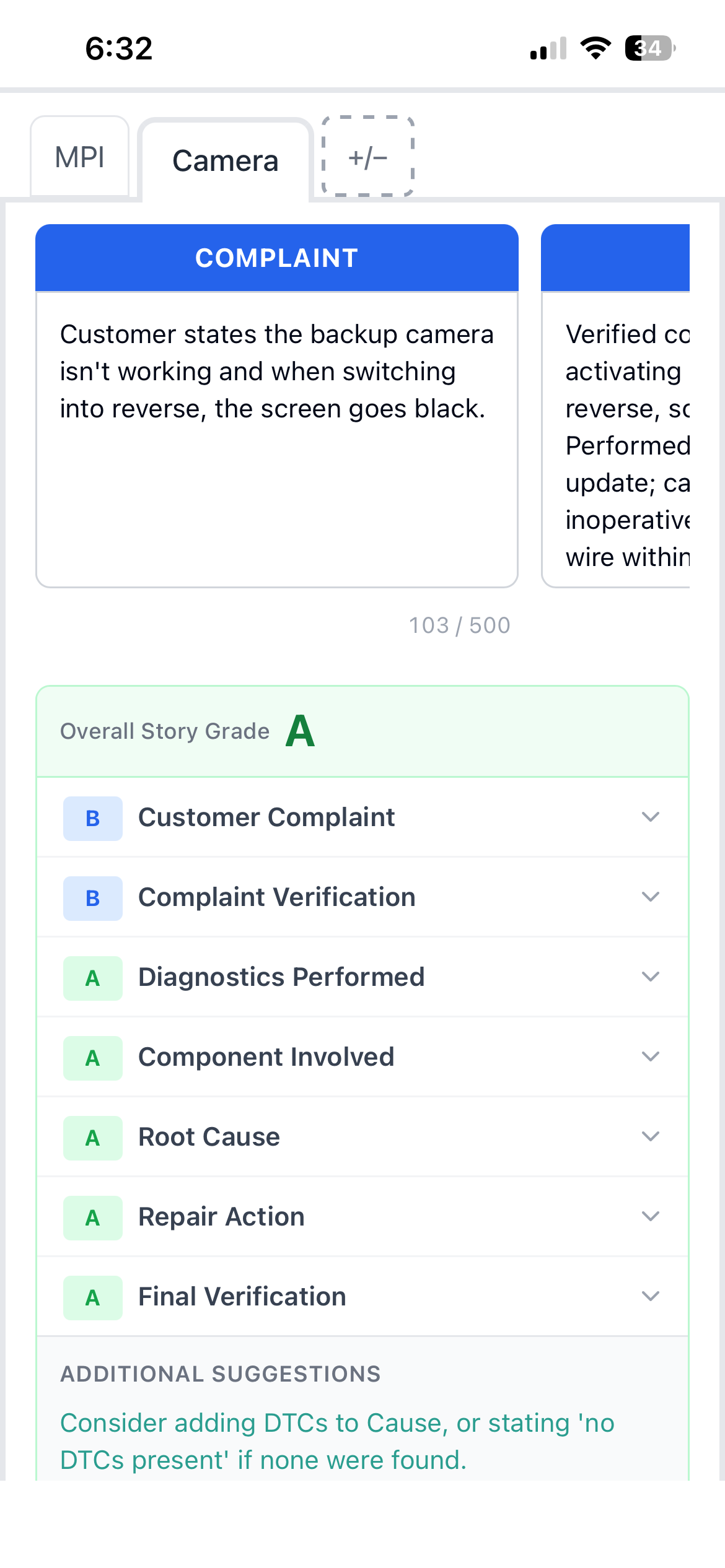 The grading system scores each story against the criteria OEMs use to evaluate claims, so your service manager can spot weak documentation before it ships to the manufacturer. Not after it comes back denied.
You can see how shops are putting this into practice in our beta feedback roundup.
The Math on Getting This Right
Consider a dealership doing $150,000 a month in warranty work. At a 12% denial rate, that is $18,000 a month in denied claims. Even if half of those eventually get recovered through rework and resubmission (which is generous), that is $9,000 a month in lost revenue. Plus the advisor and admin hours spent chasing those denials instead of writing new ROs.
Now consider what happens if you cut your first-submission failure rate in half. Not by hiring a warranty admin. Not by running another training session that everyone forgets in two weeks. Just by capturing the information your techs already have in a format that OEMs accept.
The return on better documentation is one of the clearest wins in a service department. The revenue is already earned. The work is already done. You just need to get paid for it.
Start Getting Paid for the Work You Already Do
Every denied warranty claim represents work your tech already performed, a repair your shop already completed, and revenue your dealership already earned. The only thing standing between you and that money is the documentation. That same documentation also sets what the work pays, because it is the basis for raising your warranty labor rate to retail.
RO.bot’s voice-first 3Cs documentation helps your techs produce complete, properly structured warranty stories in seconds instead of minutes. No typing. No training techs to write differently. Just better documentation from day one.
Book a demo and we will walk you through exactly how it works with your team’s real workflow. Fifteen minutes. No pressure. Just a look at what your warranty recovery could look like when every story is complete the first time.