The Cheapest Revenue in Your Store Is Sitting in Declined Work
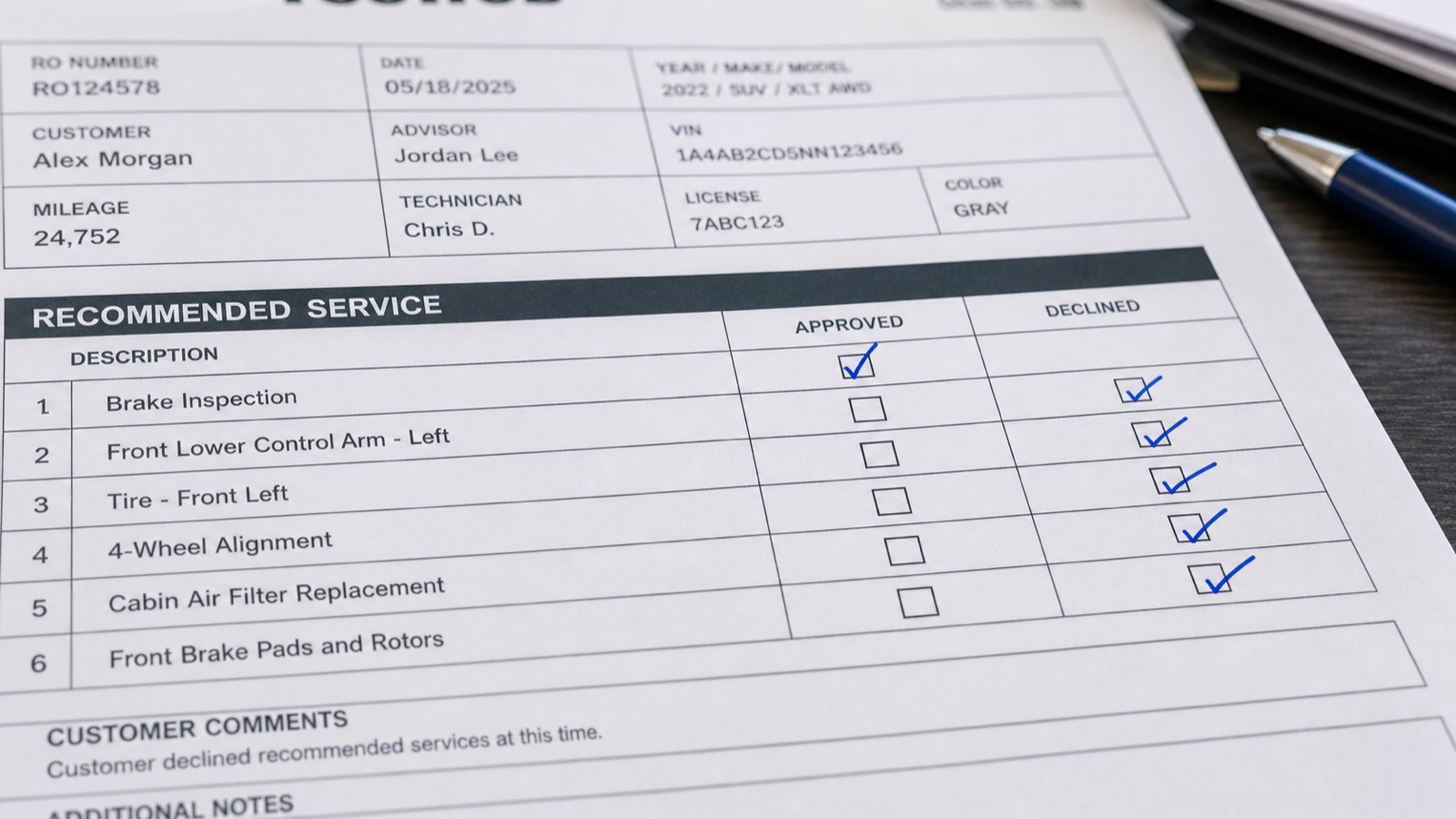
Every repair order that leaves your service drive with a declined line on it is work your team already found and never collected.
The tech found the worn control arm. The advisor wrote it up. The customer said “not today.” And then the most valuable list in your entire dealership, the work your own techs already recommended, goes into the DMS and never comes back out.
The short version: declined service work is the cheapest revenue you will ever recover, because the selling is already done. Most of it never gets a follow-up call, and the reason is rarely a lazy advisor. It is a recommendation documented too thin to pick back up sixty days later.
That gap, between a recommendation made and a recommendation someone can act on two months later, is a documentation problem, not a discipline problem. It is the reason we built RO.bot, and we will come back to what it changes. First, where the work goes.
Two terms, because shops use them loosely. Declined services are the repairs a customer said no to at the counter. Deferred services are the ones they said “not yet” to, the maintenance they plan to come back for. Both sit as lines on a closed RO, and both are worth money. Deferred is the easier of the two, because the customer already told you they intend to return.
Why does declined work never get followed up?
If your declined-work recovery is weak, it is almost never one big failure. It is six small ones, and you have probably heard every one of them on your own drive:
The advisor is slammed and running on memory. A busy advisor is juggling fifteen to twenty open ROs, and most of the afternoon is status calls from customers asking if their car is done. The intent to call back the no’s is real. The time never shows up.
The advisor already decided the answer is no. A slammed advisor sizes up a customer, figures they will not spend the money, and never makes the pitch. The trade has a name for it, selling with your wallet. Other times the recommendation gets made out loud but never logged on the RO. Either way the decline is invisible, and you cannot follow up on a no that was never written down. A low declined-services count is not good news. It usually means the no’s are not getting captured, not that customers are saying yes.
The DMS buries it. The decline sits in closed RO history. Nobody runs the declined-services report, and the system never pushes it back in front of anyone. Out of the report, out of mind.
Nobody owns it. Is the callback the advisor’s job, the BDC’s, or nobody’s? When the answer is unclear, the answer is nobody’s. The end-of-month BDC blitz against the whole list feels like effort and closes almost nothing.
The note is too thin to re-quote. “Front brakes” tells the next person nothing. Two months later, no one can confidently re-price it or re-pitch it, so they do not. The recommendation died at the write-up, not at the callback.
The advisor expects to get burned. The customer already said no once. To someone running fifteen ROs, calling back feels like volunteering to be a punching bag. You know it is going to get turned down, so why bother. The call quietly drops off the list.
Notice what most of these have in common. The villain is not a lazy advisor. It is a recommendation that was either never captured or captured too thin to act on. Fix that, and the follow-up becomes possible. Skip it, and no CRM campaign in the world will save the work.
Here is the part shops talk themselves out of: a customer who declines almost never means never. Ask any tech about their best customer who turned down a repair and you will hear a version of the same story. The guy declined the shocks, then came back two weeks later because he had ordered the parts himself and just wanted them installed. The no meant not at this price, or not until I understand it, or not from the person who just made me feel upsold. Industry trainers put recovery on documented, well-timed follow-up at 15 to 25 percent of declined work. That number only exists because the original no was situational, not final.
What declined work is actually worth
Most Fixed Ops Directors have never sat down and run this math on their own store. The numbers below are illustrative, but the shape holds anywhere. Walk it through with your own declined total and the answer rarely gets smaller.
For a sense of scale, 30 to 40 percent of the work your techs recommend gets declined. That is the same revenue-per-RO leak we walked through from the other direction here, coming back at you from the service drive. It is not new work. It is work your techs already found and your customers already heard.
How to actually recover declined service work
The recovery process is not complicated. It is four steps, and every shop skips the first one.
1. Capture the recommendation like a stranger will read it cold. The line has to survive the handoff to whoever makes the call. Specific part, what the tech actually observed, why it matters, and a rough timeframe. “Front brakes” is not a record. “Front pads at 3mm, customer drives 80 miles a day, recommend within 60 days” is a record you can sell from two months later.
2. Time the follow-up to the reason, not the calendar. A customer who deferred on timing gets a call near their timeframe, not at month-end with everyone else. Most declined lines start as findings on an inspection, and the shops that complete more thorough inspections have better notes on why each item was declined in the first place.
3. Make the callback specific. “We had some recommendations last visit” earns a no. “Last month your tech flagged the front brakes at 3mm and you were driving 80 miles a day, I want to get you in before they go metal to metal” earns an appointment. If the original decline was a communication problem, send a clear inspection video, not a price.
4. Give it an owner. Follow-up that belongs to everyone belongs to no one. One named person, or one BDC seat, with the declined report actually in front of them, beats good intentions spread across a slammed drive.
Every one of those steps depends on the first one, and the first one is the one shops skip. You cannot time, personalize, or re-quote a recommendation that reads “front brakes.” The record has to hold the detail, and it has to get captured without asking a tech who is already behind to stop and type a paragraph.
Here is the part that should make this easy. Your shop already documents declines. Every tech who has been burned writes “customer advised, declined repair” on the RO to protect the shop if that car comes back on a hook. That instinct is correct. It is just aimed at the wrong target. A note written to cover you in a dispute reads “declined brakes.” A note written to sell the job in sixty days reads “front pads at 3mm, customer driving 80 miles a day, declined today, recommend follow-up within 60 days.” Same thirty seconds. One protects you. The other pays you.
That is the problem RO.bot was built around. Techs talk through what they found while they are still standing at the car, and the system writes it down in their words, in detail, the first time. The same documentation discipline that makes a warranty story hold up makes a declined line recoverable sixty days later. A recommendation you can actually read is a recommendation you can actually sell.
The list is already yours
You spend real money chasing new service customers, and the math on acquisition keeps getting harder. Cox Automotive’s 2025 study finds dealers now capture just 29% of their customers’ service visits. Meanwhile the warmest list in the building, customers whose own vehicles your own techs already inspected, sits in the DMS waiting for a call that never comes.
Recovering declined work is not a marketing campaign. It is documentation plus a phone. Fix the record at the point of capture, give the follow-up an owner, and the cheapest revenue in your store stops rotting in a report nobody runs.
If you want to see what your techs’ recommendations look like when they are captured in full the first time, book a demo. We will run a few of your real inspections through the system so you can see the difference between a line you can recover and a line you already lost.