Who Eats Your Warranty Diagnostic Time?
TL;DR
Warranty diagnostic time is the labor a tech spends finding a cause before a repair is approved. Depending on OEM policy it may be bundled into the repair labor op, paid under a separate or no-problem-found allowance, gated behind authorization, or not covered at all. What policy does not pay, your tech or your service gross does.
Every other labor line on the RO has an owner. Diagnostic time is the one nobody wants to claim. Sometimes the manufacturer folds it into the repair labor op. Sometimes it carries its own allowance. Sometimes it needed an authorization your advisor never got. And sometimes the policy simply does not pay for it. So the two hours your tech spent chasing an intermittent no-start still have to land somewhere, and at most stores they land on the tech.
What is warranty diagnostic time, and who pays for it?
Diagnostic time is the labor between the customer’s complaint and a confirmed cause. It is not the repair. It is the work of proving what failed and why, and on a late-model vehicle it is most of the skill in the job.
There is no single answer to who pays, which is exactly why it leaks. Under a given manufacturer’s policy, diagnosis on a warranty line may be:
- Built into the repair labor operation, with no separate diagnostic line to claim
- Paid under its own diagnostic or no-problem-found allowance, sometimes per concern, sometimes per visit
- Gated behind prior or supplemental authorization, where the hours past a threshold need approval before the tech spends them
- Not covered at all, when the policy makes no provision for the outcome you ended up with
A third-party service contract adds its own rules on top, and the customer becomes responsible only when diagnosis establishes a cause that is not covered. When none of those paths pays, two more absorb it. Your tech eats the hours as unpaid flag time, or you internalize the labor and watch it come off service gross as unapplied time.
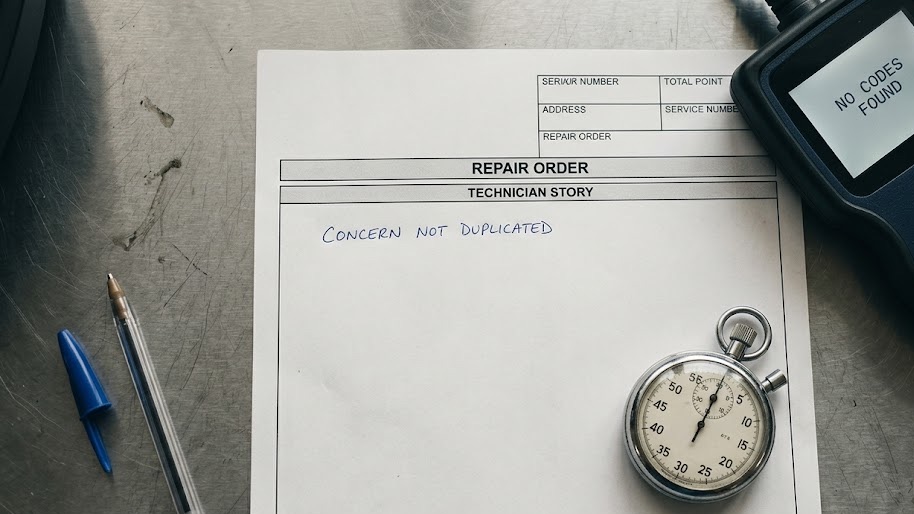
No problem found, concern not duplicated, could not duplicate: same thing?
In the bay, yes. NPF, CND, could not duplicate: all of them mean the tech could not reproduce what the customer described. Advisors and techs use them interchangeably and nobody blinks.
In your franchise’s warranty policy, they may not be interchangeable at all. Manufacturers define and code these outcomes differently, and some attach a specific allowance to a specific code. A no problem found warranty claim submitted under the wrong term for your brand can be the difference between an allowance and nothing. This is worth ten minutes with your warranty administrator, not because the vocabulary is interesting, but because your claim system may only recognize one of them.
Why won’t the manufacturer just pay for the time it took?
Because the allowance, where one exists, comes from a time guide, and a time guide is built around a known repair. Diagnosis is the part of the job where the repair is not known yet. The guide can tell you what replacing the part pays. It cannot tell you what finding it pays.
The worst version is the concern your tech cannot duplicate. In a r/serviceadvisors thread on no-problem-found diagnostics, advisors compared what their franchises pay for a concern that could not be reproduced. One described three tenths of an hour. Another said their brand would go to an hour and a half, per concern, for the identical outcome. Five times the pay for the same result on the RO. What stood out was not the spread. It was that most of the thread had to go look up their own store’s policy before they could answer.
Three ways a diagnostic hour gets paid
The rate fight is mostly won. The time fight is just starting.
Most states now require manufacturers to reimburse warranty labor at or near your retail rate. That is the fight worth filing for, and it is covered in how to increase your warranty labor rate to retail. But rate is only half the equation. Rate times time is what you get paid, and while dealers were winning on rate, the manufacturer kept control of time.
That is changing, and it is the part most stores have not noticed. According to a Nelson Mullins analysis of state warranty statutes, states are moving the benchmark away from OEM-defined time guides toward the guides dealers actually use, and the firm notes that labor-time calculation is where the most legislative experimentation is now happening. Illinois and Montana moved in 2021, Minnesota in 2023, New York and Alaska in 2024. Virginia and Wyoming took effect in July 2025, and New Jersey’s took effect April 1, 2026.
Watch where the argument is going. A bill sitting in New York’s Senate Rules Committee, A8773, would set reasonable compensation at the manufacturer’s time allowance multiplied by 1.5 where a third-party guide does not cover the repair. Where no time allowance exists in any guide, it would make reasonable compensation the actual time taken to perform the repair, as documented by the dealer.
It is a bill, not law, and it may die in committee. One bill in one state is not a national trend, and nothing here is settled. But it is a fair signal of where the scrutiny is heading. Legislators have started arguing about how warranty labor time gets calculated and documented, not just what the hour is worth. That argument was not happening five years ago.
So what can you actually bill?
| Situation | Who pays | What it turns on |
|---|---|---|
| Concern duplicated, covered failure | Who pays Manufacturer, under the repair labor op or a separate diagnostic allowance | What it turns on Coverage first. Then a cause tied to the specific failed part and a correction that matches |
| Concern not duplicated (NPF/CND) | Who pays Manufacturer, only if the policy provides an allowance, often per concern | What it turns on Your franchise's published policy, plus a story showing the conditions tested and the result |
| Physical damage, rodent, over-rev, abuse, aftermarket parts | Who pays Customer, once diagnosis establishes a non-covered cause | What it turns on Written authorization at write-up, plus documentation of the cause. State law and OEM policy set the limits |
| Third-party service contract | Who pays The administrator, if authorized first | What it turns on Approved hours and rate in writing before the tech starts |
| Customer-pay diagnosis | Who pays Customer | What it turns on An authorized amount at write-up, not a conversation at delivery |
Three of those five rows are settled at the counter, before the car reaches a bay. The other two come down to a policy you do not control and a story you do.
What documentation can and cannot do
Be honest about what a story is worth, because vendors in this space routinely oversell it. Documentation cannot create coverage. It will not conjure an allowance your franchise does not publish, and it cannot retroactively authorize an hour nobody approved. But missing documentation can kill an otherwise payable claim, and that happens constantly.
Here is the trap. A tech spends two hours on an intermittent no-start, finds nothing, and writes one line: could not duplicate. It is true, and it is close to worthless. There is nothing for a warranty administrator to submit against a CND allowance, nothing to appeal with, and nothing to show an auditor who wants to know what those two hours bought.
"Could not duplicate customer concern."
Nothing here tells a reviewer what was tested, under what conditions, or what the two hours bought.
"Road tested 12 miles from cold start. Monitored fuel pressure and misfire counters during acceleration and hot restart. No DTCs stored or pending. Concern did not occur under tested conditions."
Identical outcome, identical hours. This version gives a reviewer something to submit and an auditor something to follow.
Illustrative only. This is not an OEM-compliant template, and the stronger version does not guarantee payment.
Both techs did the same work and reached the same conclusion. Only one of them left a record. If your policy pays a CND allowance, the second story gives the claim a chance and gives you something to defend in a warranty audit. If your policy pays nothing for that outcome, no amount of writing changes it, but at least you can see what the two hours cost before you decide who absorbs them.
What should a service manager check this week?
Where RO.bot fits
RO.bot will not set your allowance, win your rate case, or make a non-covered repair covered. It works on the one input you actually own, which is the record your tech leaves behind.
The tech talks through what they did, the conditions, the tests, the readings, and the story comes out written in the order a warranty administrator reads it. Every diagnostic warranty story gets graded against six criteria before it ships, and one of them is the diagnostic approach: does the story show the tests that led to the cause?
It also will not invent one. If the tech never said they ran the test, the test does not appear in the story. That constraint matters when the next person reading the story works for the manufacturer.
The diagnostic hour happens either way. Your tech spends it. What varies is whether anything on the RO shows what it bought, and at a lot of stores the answer is one line saying the concern could not be duplicated and a tech who quietly ate two hours. Policy decides what you can claim. The story decides whether you can defend it. Your tech is keeping score on both, even if your DMS is not.